Technology has become disrespectful
When I was growing up, my family had a computer nook. To get to it, you went down the stairs to the basement, turned past a castle playset and tiptoed over a sprawling Lego shanty town. There below a ground-level window was a plain wooden table with a monitor whose depth exceeded its width. On the carpet below sat a hulking box of matte-gray plastic and metal emblazoned with a silver medallion that read DELL. The power button sparked to life when you pressed it, then pulsed an otherworldly green. The computer would take a good minute to start up, so you had time to look outside at the birch tree, bark fluttering in the wind. Sometimes a squirrel would bound past. Otherwise, you watched the occasional car negotiate the curve on the road past your house. Then the computer finished booting, and you were online.
When you were finished, you turned the plastic box off and left the computer zone. As a relatively video-game-obsessed kid, I would count down the minutes until I could get back. I fantasized about a future where a computer would always be available, maybe embedded in my glasses, so that I would never have to suffer being offline. Now, as I sit on my couch typing this essay on my laptop, the computer zone is everywhere. My laptop was already on this morning, and it only took milliseconds to wake. I can bring it with me wherever I go. And in many ways this is fantastic. I can go work from a coffee shop or look up a recipe in the kitchen. And, of course, my phone is now more powerful than any home computer was back when I was growing up. And yet, the idea of becoming even more enmeshed with technology, perhaps in the form of smart glasses or a futuristic brain interface, fills me with dread. So what happened in the intervening twenty years?
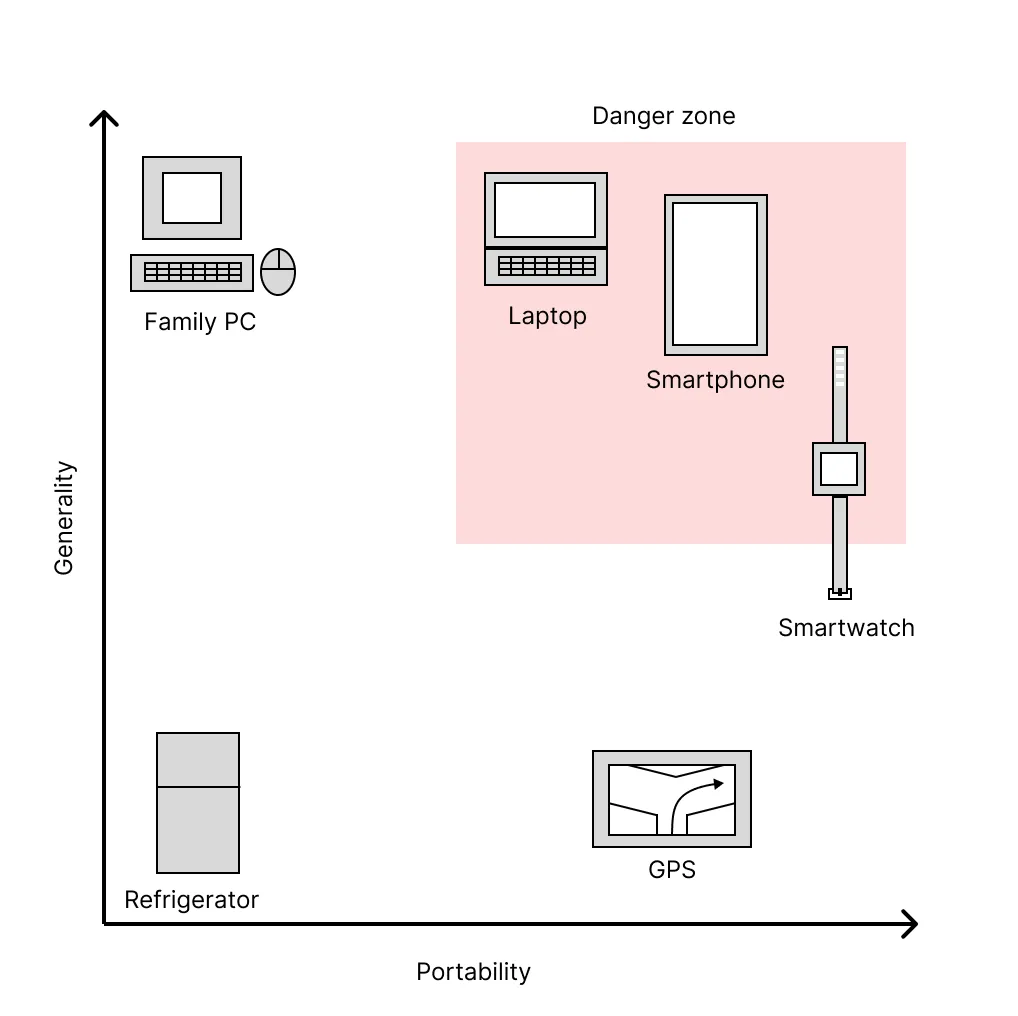
You can plot technologies on a graph where the x-axis is portability, and the y-axis is generality. In the bottom left quadrant, you’d have technology like a refrigerator or a landline phone. This type of technology has one use case and can’t be easily transported elsewhere. In the top left, you have technology that is general-purpose, but not portable, like the old-school PC that I grew up with. (Although not very portable, I did manage to take it with me to the occasional LAN party with my friends. The very act of loading the PC into our family van felt like a major event.) Then in the bottom right there are highly portable but hyper-specific technologies, like the first-generation of car GPSs or eReaders today. Finally, we arrive at the top right: the problem quadrant. Highly portable technology that does not have one defined use case, like a laptop or smartphone or smartwatch. Think of any new technology you interact with on a daily basis. Where does it fall on this graph?
One thing the computer nook got right was that general-purpose technology is less destructive when it’s tied to a physical place. You have to choose to access it. The technologies in the top right of the graph are with most of us every second of the day. We can turn to them whenever, and often do. We call this technology distracting, but I’d go a step further and say that it’s in fact disrespectful: of us, of our limited time, of what we try to accomplish each day.
Here’s an exercise: for one day, whenever you pick up your smartphone, ask yourself what goal you had when you picked it up. Did you want to check the weather? Message a friend? Or were you just trying to kill some time, play the slot machine of social media? (Or maybe play an actual digital slot machine.) When I did this exercise, I was startled by how often I would pick up my phone for no reason whatsoever. The physical action came automatically and the rest tumbled out like a stone rolling downhill: check messages, check forums, check the news. Maybe I’d study my digital flashcards for Italian, but often I’d find some way to distract myself first. It felt bad to realize how I’d trained myself to do something so aimless. Was my willpower to blame?
To say that these technologies are distracting lets them off lightly. It leads you to conclude that if the user just had more willpower, they’d be fine. Reframing this technology instead as disrespectful not only does us the service of acknowledging how hard these technologies are to quit, it also recognizes the fundamental nature of these devices to provide us with endless side-quests that lead nowhere. It’s hard to get distracted by an AM radio, but it’s easy to get distracted when you have the entire corpus of all recorded music and podcasts and audio books at your fingertips at all times.
I have at various points cleansed my phone of distracting apps, going so far as to block my access to a web browser completely. It was jarring at first, but it led me to check my phone less often and be more present in daily life (as well as to make real progress on my Italian). However, for whatever reason, these changes never ended up sticking, and after a few weeks I’d end up right back where I started. After a few cycles of this, I was fatigued. It feels like I have to constantly negotiate my relationship with technology and figure out what serves me and what is just a new avenue for distraction. And the machines never sleep and are only a nightstand away.
So I’ve instituted a few basic rules: no phone in the bedroom, laptop only at my desk (most of the time), headphones stay at home when going out for walks. It helps reduce some of the danger of the upper-right quadrant, but it doesn’t change the fact that distraction is nipping at my heels. I used to look forward to getting a new smartphone every two years. Now I’ve had my current one for four, and I’m not sure if I’ll buy another. I’d rather spend my time with technology that respects me. Or maybe I’d just stare out the window and watch the pigeons sitting toad-like on the fire escape. I imagine they’re quite content.
Thanks for reading. If you enjoyed, I’d appreciate if you checked out Bema, a work messaging app that respects your time.